Wednesday, July 29, 2015

Woefully Ill Equipped


A month of Cross-Cultural training has taught us many things but the thing that sticks out the most is that we cannot do this. This training has made us feel like this:


We have no idea how to communicate on a heart level with the Shawi or Peruvian people in Yurimaguas.  Even though Jennifer speaks Spanish, communicating at that level is something different, and the rest of the family doesn’t speak any Spanish.


We have no idea how to move our family to another hemisphere.  We have struggled to move them to North Carolina temporarily.  Henry asks when we can go home.  For that matter, he still asks to move back to the house we moved out of 10 months ago that was ¼ mile down the road from our current house.  Lucy is struggling with missing friends and family at home.  They have also both experienced intestinal issues here which is not common for them and we’re wondering how much is due to all the changes in their lives. These are all things that are not going to get any easier, only harder.


We have no idea how to maintain our marriage throughout this who process.  We’ve talked about it in class but we recognize it will be a challenge.  We’re both struggling emotionally with different things.  We love our children – but they are always with us – and this is likely to continue for some time as we leave family and our supply of babysitters.  It is hard to find time to be alone together and emotional energy to connect. 

We have no idea how to live in a city.  We are country people.  We like our space and our privacy.  We enjoy our quiet road that we can run and walk on and our acreage we can play on without interruption.  We are still in the country during training, but we live in an apartment complex and are with great people all the time and it is exhausting.  Our children are making wonderful friends and enjoy having 24 hour a day playmates, but it is hard to find quality family time.  How much more difficult will this be in a city where we found little green space or recreational options?


We have no idea how to engage in spiritual warfare – and they assure us it is coming.  Not just at us but at our children as well.  We have no idea how to keep our children safe. Likely we won’t succeed and they’ll end up with parasites and possibly even malaria and who knows what else.


We have learned how incapable we are.  Yet we must go.  We can’t not go.  As much as we long for God to call us to Goshen, to family, friends, safety, and what we know, He has not.  As hard as this is and is going to be, He is using it for His glory and purpose.  He is doing a work in us and we have faith that He’ll use us to continue His work in Yurimaguas because He has called us there.  


We have also learned the joy in being incapable.  Where we are unable, God is able.  Where we are weak, He is strong.  When we surrender, He is mighty.  We are learning to rely on and trust Him for everything because we cannot do any of this.  One does not have to be called into missions for this, but He is using this calling in us to humble us in a new way and to draw us closer to Him.  For that we are very thankful.


There is no way that this should work. It is not efficient for someone to enter another culture, learn the language, and present the gospel. Why would God use this method to spread his love? Why would God use us when we are so incapable? So ill equipped? We voiced this concern to a facilitator here and he made things clear when he said, “that proves God’s existence, if He can use a weak fumbling idiot like me to spread the gospel that proves how great and powerful He is.” Our ultimate goal is NOT for people to look at our lives and say “wow, they are good people” our goal is for people to look at our lives and say, “wow, God is a great God” After a month here we feel completely beaten down, but that is good. Now we can truly say: I delight in weakness, in insults, in hardships, in persecutions, in difficulties. For when I am weak, then I am strong. 


 "But he said to me, “My grace is sufficient for you, for my power is made perfect in weakness.” Therefore I will boast all the more gladly about my weaknesses, so that Christ’s power may rest on me.  That is why, for Christ’s sake, I delight in weaknesses, in insults, in hardships, in persecutions, in difficulties. For when I am weak, then I am strong."                                                                                         2 Corinthians 12:9-10
                                                                                                                             ~ Josh and Jennifer


Wednesday, July 1, 2015

Hogar Materno


God has called us to join the work of Susan Holowecky and her staff at Hogar Materno "Hannah".  The home serves pregnant women and mal-nourished children in and surrounding Yurimaguas, Peru, mainly the Shawi people.The picture above is in an older part of the Hogar. The building was in poor shape and is now in the process of being torn down and rebuilt, hence the mess.

Who is served
The Shawi are an indigenous group of the Amazon jungle.  They have settled into small villages along the river and suffer from poverty, poor nutrition, discrimination, and lack of education.  There are some women and children from in town who also benefit from services of the hogar.

Services  Offered

Maternal Care
Maternal death during childbirth is a large problem and travel into town for medical care can take days.
The hogar is a safe place where high-risk women can come and stay while they wait to deliver their baby at the hospital in town.  They are provided safe shelter and nutritious meals as well as Christian fellowship and Bible study.  Women may be there anywhere from one day to a few weeks.

Re-nutrition Center
The hogar also helps to rehabilitate mal-nourished children.  These children sometimes come to the hogar from the hospital for additional care before returning to their village and sometimes parents bring children their directly.  Sometimes children are left at the hogar alone, other times the mother and possibly siblings will stay as well.  Many children suffer from parasites.  They are treated with anti-biotics and hygiene habits are also taught to help prevent future problems if possible.  Other children are simply starving and the hogar provides nutrition for them to gain strength and weight.


This sweet 3 month old named Milagro (miracle in English) is the size of a newborn except for her newly filled out cheeks.  She came to the hogar at just 1 month of age.  Her mother died during child birth and her father tried to keep her alive as best he knew how.  After a month of feeding her only the fermented root beverage they drink in the jungle, he knew she was dying and brought her to the hogar for help.  She has gained weight but still has a long way to go.  She does not support her weight at all yet and her limbs are still the size and maturity of a newborn.  Please pray for a miracle for Milagro as she recovers at the hogar.


The older boy in this photo is at the hogar with is mom and 3 siblings.  They all have parasites and are suffering from lack of nutrition but the littlest one is the worst.  They should be able to return to their village soon.  The little guy in the stroller is 8 months old.  He and his twin brother were brought to the hogar for care by their father after their mother abandoned them when they were just a month or so old.  They will continue to grow and gain strength at the hogar and dad will come back for them once they're older and he can manage them.  Formula or adequate nutrition for infants is not something the Shawi people have access to in the jungle or can afford in town.


The hogar is staffed 24 hours a day by wonderful Christian Peruvian women.  We were blessed to join them in their weekly prayer meeting and hear their hearts as they prayed over the women and children they serve.  They work tirelessly cooking, cleaning and doing laundry as well as loving on the children who don't have parents present at the hogar.  Women who are at the hogar either to deliver or while their child is rehabilitated do their own cleaning and laundry.


Home
The hogar has become home to 5 children who came for rehabilitation but were then abandoned.  Susan is in the process of trying to adopt these children and this past January they moved into their new home at the hogar with their mother.  The children enjoy the best of both worlds - they love the staff and children at the hogar and being close by but they also love having a home and mother to return to.

Their Home


Susan & her children (plus 1 extra!)


~ Jennifer

Monday, June 22, 2015

Where are we?


Our first day in Yurimaguas, Peru was a little different then we had experienced before. It was Sunday and we had planned to go to church at a Shawi village. The hotel restaurant was supposed to open at 6:30am. We woke up early to the humid jungle heat. Arriving at the restaurant promptly at 6:30am we find it closed. Around 7 they finally opened and we went in and sat down. The waitress told us they had a chicken sandwich for breakfast and asked “would that be ok.” What option did we have? We wanted breakfast so chicken sandwich it was. Then she asked if we were in a hurry? We told her our driver was picking us up at 7:15am and she responded, “esta bien.” She yelled something at the cook, then turned and ran out of the restaurant and down the street. The cook took a whole fresh chicken out of the fridge and began hacking it up with a butcher knife. A couple of minutes later the waitress returned with bread and we had the freshest chicken sandwich ever. Thanks to our driver being late, we even got to eat it. 
Next we took off out of town on a little dirt road that lead into the bush. The road was rough but passable…at first. Susan, our hostess told us that sometimes the road is too bad to get all the way through and we may have to hike the last couple of kilometers. The first hour on the road was pretty good. Passing the occasional plantain farm or cattle ranch.

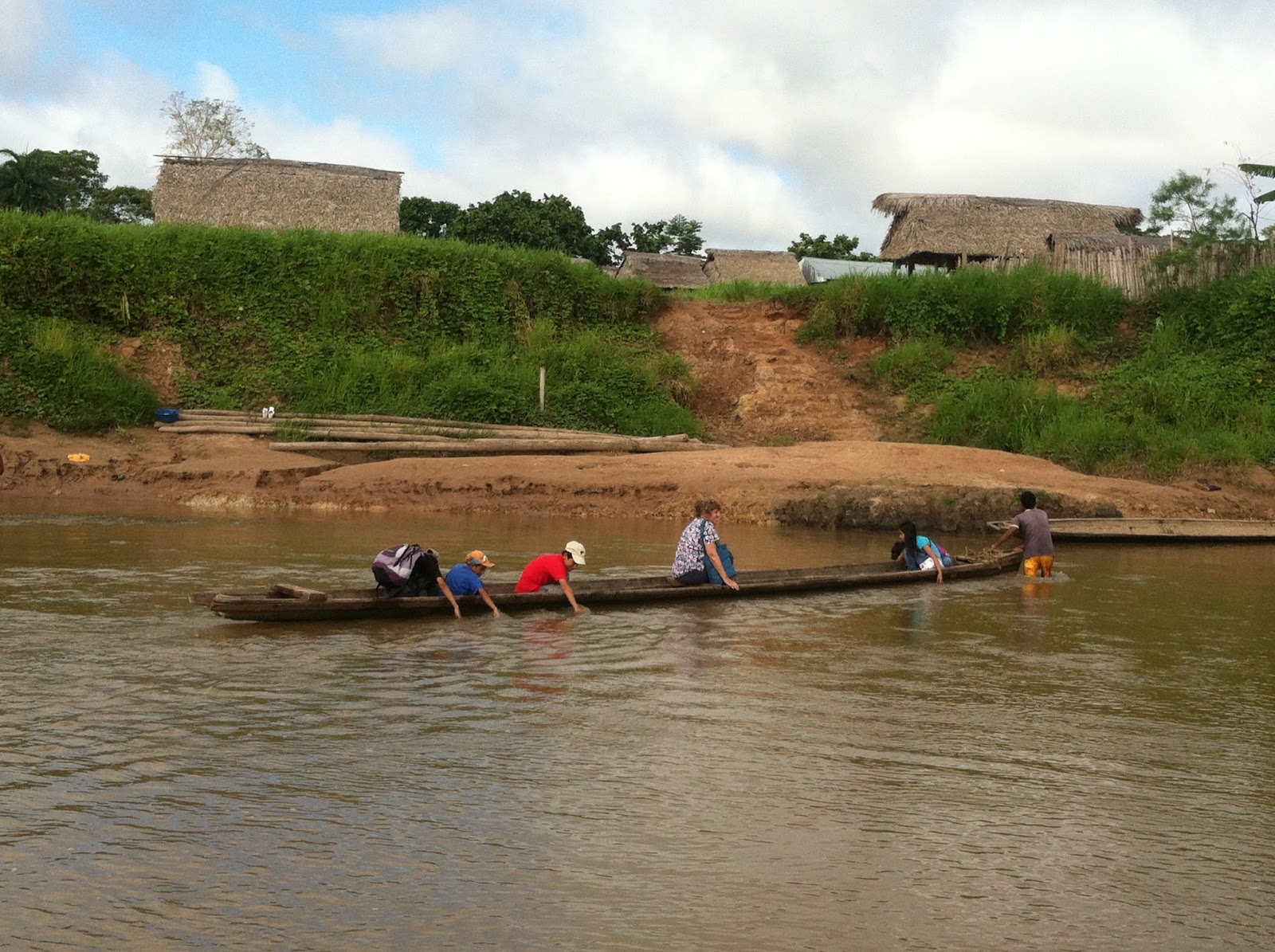
We passed through these little villages with names like, San Lucia, San Antonio, and San Lorenzo. The houses were mostly one room with grass thatch roofs. Then the road got really bad with deep ruts and I began to pray that we could make it to church. I realized that it was the first time in my life that I prayed for God to help us get to church. Strange. After a long time Susan thought we might have missed our stop and asked the driver to pull over. After he stopped, she looked around and realized that we were parked next to the exact path we need to take to get to the village. More of God's provision to get to church. We hiked about a half mile through the jungle till we came to a river. On the other side of the river we could see the village and a couple of dugout canoes tied up on the bank. A man was bathing in the river while another man brought a canoe over to our side.

It took two trips for us to get across because we had five young children with us. After crossing we had to hike across a grassy field surrounded by small thatch roof houses, then up a hill to the church. The church was an open pavilion with a metal roof and a couple of handmade benches. The women wore bright colored skirts and tops. Most of them had a baby attached to their hip with a blanket. They had what looked like painted faces or tattoos. I latter found out that this was done with a plant in the jungle and stays on for up to two weeks. The men dressed in American clothes,and some had the same tattoo paint on their foreheads. A couple of men were playing guitar as we arrived. Three of the women were dancing in the front of the congregation and I noticed their feet and ankles were also tattoo painted. All the women danced with what looked like a string of walnut shells. The sound of the shells jingling to the music was almost magical.


  As soon as the music ended we were asked to get up and introduce ourselves and give them a greeting. Then the children were dismissed to a house with Jennifer and Susan for Sunday school. Arlen King, director of Missionary Ventures USA, was with us and got up and began preaching. The men speak Spanish but many of the woman only speak Shawi. As a result Arlen asked one of the men to translate. It was difficult to concentrate on a sermon preached in two languages I don’t understand but it gave me time to reflect on the beauty and diversity surrounding me. What a strange people and strange place yet it was beautiful to listen to their worship and to listen to the word of God as the read from the Bible in Shawi. After the preaching there was more worship and a giving of offerings. Then church ended with handshakes and blessings. We brought some candy to share with the children and it was so interesting to watch the little kids try to eat it with the wrapper on. 

We said our goodbyes and crossed back over the river with the help of some boys from church who couldn’t have been older than 8 or 9. Back on the road I forgot to pray for safe return and we were soon stuck. God provided again as a van load of men came down the road and about 6 to 8 of us pushed and sweated in the heat for about 10 minutes until we were back on the road again.   


Back on the road covered in mud and sweat I realized how remote we were, there is no cell phone service and no electricity. We were a solid day hike from town and if we did not get out of that hole in the road I am not sure what we would have done. About an hour and a half later we finally made it back to Yurimaguas. What an adventure. What a God we serve.
                                                                                                                                                  ~ Josh
 
"Everyone who calls on the name of the Lord will be saved. How, then, can they call on the one they have not believed in? And how can they believe in the one of whom they have not heard? And how can they hear without someone preaching to them? And how can anyone preach unless they are sent? As it is written: "How beautiful are the feet of those who bring good news!" Romans 10:13-15


Tuesday, June 16, 2015

Hogar Games

Learning a new jump rope game with the children at the Hogar, in Yurimaguas, Peru.  They are much better than I am.


Monday, June 15, 2015

Jungle Rain

What does rain look like in the rain forest? Not sure this video does justice. Imagine the hardest rain you have ever seen for an hour straight.