Saturday, June 25, 2016

Construction Team Trip to Yurimaguas

Last week I spent the week in Yurimaguas. An amazing group of men came from the United States to work.  They worked on the new building at the Hogar Materno Hannah installing drop ceilings, painting, and installing tile floors. Here are some of the highlights of the week:

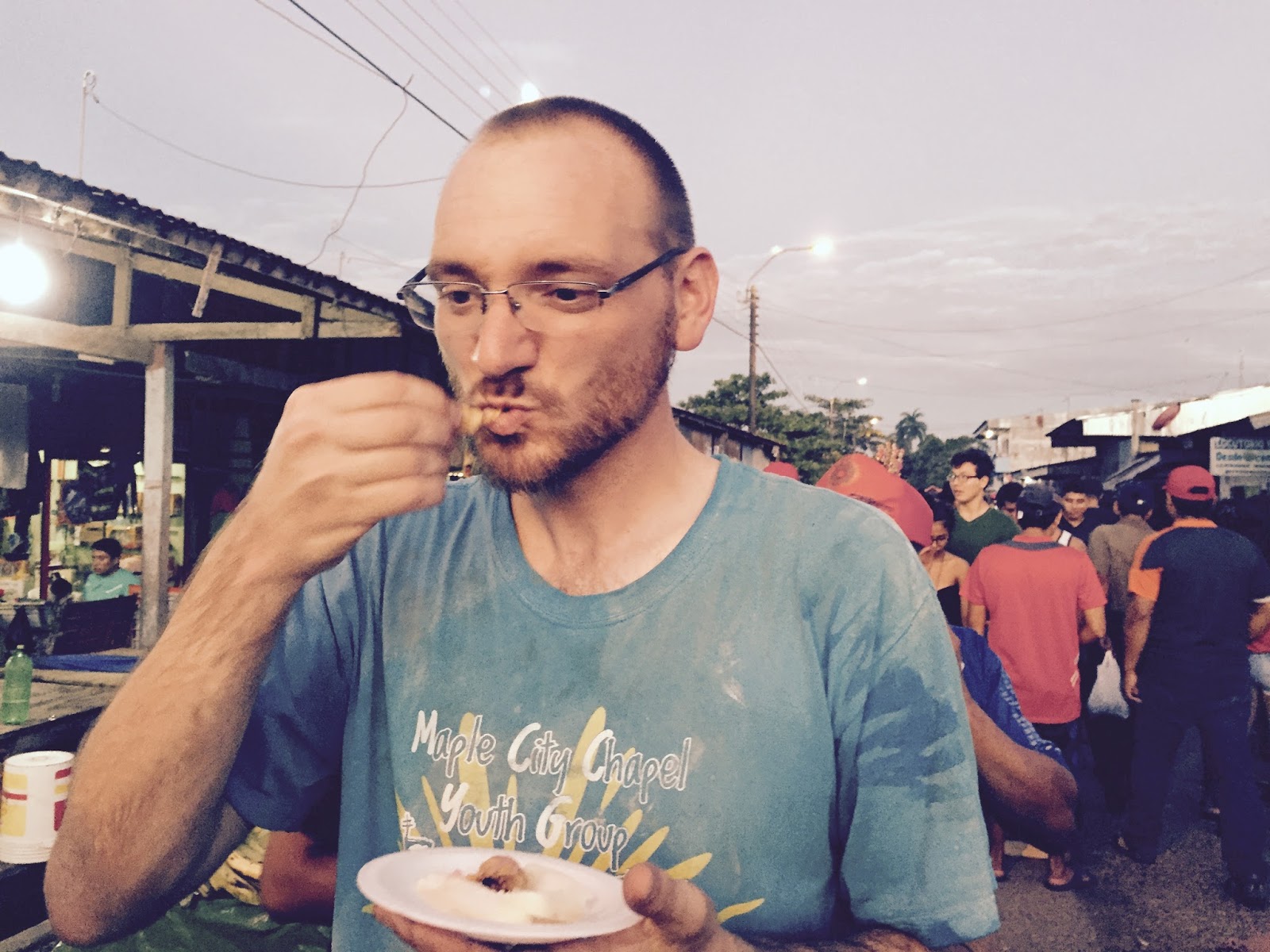
On Saturday, after a long day of work, the team and I went to a local market. We saw monkeys, deer meat, and grubs. The grubs are a local delicacy. 


 On Sunday morning we traveled to a village for church. It was about 11 miles from Yurimaguas and took over an hour to travel by van. We had a combined service with a couple of villages. This is a video of the worship.


This amazing team has been in Peru 11 times mostly serving the women and children at the Hogar through construction projects.

But more importantly these men of faith love the children, encourage the staff, preach the word, and minister to men and women in prison. Their dedication over the years has had a profound impact on the people of Yurimaguas and the Shawi people. It was a great week full of faith, sweat, and laughter.


"Give generously to them and do so without a grudging heart; then because of this the Lord your God will bless you in all your work and in everything you put your hand to."   ~ Deuteronomy 15:10

                                                                                                                ~ Josh


Friday, June 17, 2016

Necessity is Indeed the Mother of Invention

When we moved to Arequipa, we came prepared to live with what we brought in our suitcases.  We originally thought we'd take all our belongings with us on the plane when we leave but have found a shipping company which will be cheaper and easier for us.  At any rate, we rented a fully furnished apartment and haven't bought much which has led us to be creative in some ways.  Just for fun, here's a look at a few.

When Josh went to Yurimaguas in February I got the itch to organize.  Our furnished apartment has furniture and bedding, but not much else so when I decided to organize the kids toys, I used what we had - water bottles.  They work well for keeping things sorted and helping the kids find their items.


Josh got the itch to plant when spring in the Northern Hemisphere rolled around so he took some water jugs and water boxes and got some dirt from the empty lot behind our apartment.  He planted some tomato seeds from a tomato we had on the counter to see what would happen.  The shoe strings are the water wicking system he created when we went to Lima to keep them alive - the climate is so dry here they need watered daily.  We also have kitchen scraps in a trash bag on the porch composting to fertilize them.


We have found many uses for suitcases.  When we first arrived, we built a fort for the kids with them.  The photo below on the left is our laundry hamper, although it also doubles as a play pen for Maggie sometimes!  The photo on the right is Maggie's closet.  The other 2 bedrooms have a set of drawers in one closet but Maggie's room has only hanging rods and no dresser.  So, we stacked up some suitcases and 'tada' we have a drawer for her clothes.  We'll be using the suitcases again as suitcases as the end of July.  Josh and the kids will finish school on July 22 and we'll be moving at the end of the month!


Fresh coconut is common here and quite delicious.  We have enjoyed several.  However, when we brought the first one home, we didn't know what to do with it.  No problem, Josh got on You Tube and found a video of how to open one with common things you'd have around the house.  The problem was, we didn't have any of those common things around our house - no screwdriver, no hammer - no tools.  Josh misses his tools!  No worries though, Josh has always been good at finding solutions with the resources available.  So, a large knife to poke holes in the eyes and a concrete window ledge to bust open the coconut and we have a delicious snack!  We have acquired a few tools in our time here - a wrench to take the crib apart and move it into another bedroom and a screwdriver to replace handles that were falling apart on the cabinets.  Josh looks forward to getting settled in Yurimaguas so he can go tool shopping!


I'm thankful for a resourceful husband, a gift I think we'll be using even more in the months ahead!
                                                                                                                             ~Jennifer

Saturday, May 21, 2016

Sendero Luminoso


As I promised my sister here is more information on the history of the Shining Path in Peru, or Sendero Luminoso in Spanish. Sorry to those of you who do not enjoy boring political
stuff.

The story begins in the year 1968 when president Fernando Belaunde Terry was removed from office in a military coup. For twelve years the country was ruled by a radical military regime. By 1980, when Peru held popular elections again, the country was ripe for revolution. Many different groups of rebels scoured the country. One group was started by a man named Abimael Guzman. He was a professor of philosophy and began teaching communism and peasant-led revolution in the 1970’s. The group call themselves the “Sendero Luminoso” (SL) or shining path because they believed communism was the shinning path of the future, and Guzman was the self proclaimed president. By the 1980 elections, the SL had a large following of mostly rural farmers and peasants. But when they began burning ballot boxes to protest the elections hardly anyone noticed. At that point the SL was one of many rebel groups and only had a following in the sparsely populated Andes mountains. In 1980 President Fernando Belaunde Terry was re-elected and the country seemed to be headed in the right direction. But in the mountains the SL formed militia groups and took over control of large areas. The people supported them until they began to propose collective property ownership and abolishing the currency and local markets. The problem was anyone who fought the SL was killed. So by 1984 the SL was killing 14,000 people per year and controlled the central part of the country. The campesinos or rural people formed an illegal army armed with spears and slingshots to fight the SL and that only lead to more slaughters.

In 1985, new president Alan Garcia began to fight the SL by sending the Peruvian army into the mountains. The army couldn’t tell the SL from the campesinos so they began to kill everyone in infamous massacres that are still under investigation today. By 1986 the SL controlled 60% of the country and were attacking the capital of Lima. They bombed electrical towers to black out the city and detonated car bombs in front of government buildings and embassies. They also assassinated opposing party leaders, government officials, and even American and French citizens. This activity lead to the collapse of the economic system in Peru. Hyperinflation, the collapse of the currency, and huge debts followed.

Finally an independent organization called the Instituto Libertad y Democracia (ILD) got involved. The ILD identified the difference between the groups by the language they spoke: campesinos spoke Quecha and SL spoke only Spanish.  With the help of the US and ILD, the Peruvian government armed and trained the campesinos to fight the SL. The US got involved to fight communism and drug trafficking. The SL controlled the coca fields and were trafficking cocaine to US to fund the war. Once the peasants were armed, the tide turned and in 1992 President of the SL, Abimeal Guzman, was captured. After his capture the SL lacked leadership and fell apart but not quickly. The SL continued fighting for 15 more years and overall 70,000 people died or disappeared in the uprising. Even April 9th of this year one day before elections they attacked and killed 10 military personal in a remote area of the country.

Sorry to bore you with all the details but the history of the Shinning Path is important to the history of Peru. In 1990, with the government falling apart, a poll was taken and over 80% of the people supported the SL. Today although the SL is gone there is still a deep mistrust of the government by the people. Ask anyone on the street what they think of the government and you will always get a negative response. Voting is mandatory and around 15% of people spoil their vote in protest of the government. On Sunday June 5th there is a runoff election here for President of Peru. Please pray for peace and for God’s will to be done here.

I urge, then, first of all, that petitions, prayers, intercession and thanksgiving be made for all people- for kings and all those in authority, that we may live peaceful and quite lives in all godliness and holiness. This is good, and pleases God our Savior, who wants all people to be saved and to come to a knowledge of the truth. 1 Timothy 2:1-4

Saturday, May 14, 2016

5% Fluent


After 15 weeks of language school I would like to share with you a brief look at what some of my time has been like. I have two classes every day, practical class is one on one with an instructor and grammar class is in a group of 3-5.
Practical class is mostly conversation, which at first was a little difficult. My instructor Juan Carlos doesn’t speak English. The first week went like this: Juan Carlos would ask me a question in Spanish, I responded “No entiendo”, he responded “busquelo” which means look it up. I would then look in the dictionary.  After a few weeks of class he took me to buy a new one because he didn't think mine had enough words in it!  In an hour and a half of classes we might have completed 4-5 sentences. Every night I had homework, writing sentences using verbs he assigned. But evidently I didn’t understand how to use the verbs correctly, so the next day I would read my homework and Juan Carlos would look at me and say “no, no puede,” meaning you can not use it like that. Everyday, every sentence was wrong and he always responded with “no puede.” Now I am not a violent man and have never punch someone in my life but for some reason I had an irresistible urge to punch my instructor every day. I spent the majority of class with my nose in the dictionary and getting corrected every time I opened my mouth. What fun!

After practical I would go to grammar class. I have the sweetest old Peruvian lady named Abby. She teaches all the fun stuff of Spanish; parts of speech, sentence structure, and of course VERB CONJUGATION. This is in bold because it is the most important part of Spanish. They say there are 14 ways to conjugate a verb but they are wrong, it is closer to 114. Each verb has 1st person singular and plural, 2nd person singular, and 3rd person singular and plural. But that is only in present tense. There are five forms of the verb in all four past tenses, three future tenses, commands and don’t forget subjuntivo. This is a form of the verb that I don’t even know if it exists in English. It is used if you have doubt but only in certain situations and is used all the time in Spanish. It creates a soft way of speaking instead of direct and rude communication. And since I don’t know how to use it well, (yet) that makes me a rude American. Then you can change the verb to make it a noun, adjective or adverb. Grammar was my least favorite subject in grade school and so I now think I officially I know more about Spanish grammar than I know about English grammar. But that’s not saying much. My brain hurts everyday after class but at least I don’t want to punch Abby in the face. 

But 15 weeks later things have changed. I can carry on a conversation in practical class. Juan Carlos and I discuss politics, economics, and culture. We often read the bible together and pray together. Many times my homework is to read the bible and write a commentary on it. Some days we just solve the worlds problems. Other times we take field trips around the city to investigate the culture. I have been to lumber yards, home improvement stores, furniture stores, pharmacies, and insurance agencies. I’ll never forget the day he taught me how to hail a taxi and negotiate the price. I had to stand on the corner and stop 10 different taxis and ask the price to a certain location then say “no gracias” every time. After ten I figured out a fair price and stopped the next one and negotiated.  Everything is negotiable here. One day we road the combi, it is like a bus except three times the number of people as capacity and half the size of a real bus and it cost 25 cents. Standing room only on bumpy streets, in stop and go traffic, with people yelling in Spanish.  It is a real cultural experience. 


This is a combi I saw that ran into a house!


I still get corrected every sentence and look up a lot of words but I am much quicker due to all the practice I have had. In grammar I can (slowly) spit out most verb conjugations and form sentences in the correct order. Although this is very difficult with direct and indirect pronouns, I am making progress. 

My biggest frustration is how much I feel I don’t know. I assumed after a few months of language school I would be fluent.  They say that it takes 7 years to become fluent which is 364 weeks, so after 15 weeks I should be 4% fluent. That makes me feel better about myself because I am at least 5% fluent. But why didn’t God call me to study math?


Tuesday, May 3, 2016

To Lima and Home Again

Last week we took a trip to Lima.  The kids enjoyed flying again and a break from routine and school.  We were blessed to have some wonderful time together as a family.

Well, it's official.  Josh and I have been approved by the government to stay and minister in Peru.  We can now also get cell phones (and other services) in our names and obtain driver's licenses (I do not desire to drive here unless I have to!).  We have also started the process for the kids.  We will have to return to Lima at some point to pick up their carnets - then we will be finished with the process except for annual renewals which we understand are easier.

After our 6 hours at the migration office in Lima (I should have taken a picture there) during which we did homework, read books, played UNO, and ate snacks, Josh and I were able to pick up our carnets and apply for the kids.  Lucy said, "Oh good, now we can stay."  

 
To reward the children (and, let's be honest, ourselves!) we went to Parque de Aguas in the evening.  The park doesn't open until close to dark because it is a lighted fountain park.  We took towels and changes of clothes because you're allowed to play in some of them.  It's fall here and after dark it is quite chilly but the kids had a blast and it was really beautiful!


The following day we visited Parque de Leyendas, a zoo.  Throughout the park you can also see pre Inca ruins.  We enjoyed seeing animals from different regions of South America and specifically looking for animals that live in the jungle.  


There are several mission houses in Lima which are a blessing as they offer much more affordable accommodations for families and have kitchenettes so you can prepare your own meals.  Just a few blocks from the mission house we stayed in is the coast.  Our last day we spent walking to the coast and enjoying the playground.  I love to see my kids interacting with Peruvian kids and using the Spanish they've learned so far.  They had a blast - I think it was their favorite day!


Friday evening we were blessed to meet a young family who has just begun serving in Yurimaguas but who were also in Lima as they're awaiting the birth of their daughter.  One of my greatest prayers and desires was to have a good friend (and mom of young kids) in Yuri and when we decided to go, there were no other families with children there.  We're so thankful that God has provided in their family friends for our family!  They have 2 young boys and Henry and Judah became instant friends and can't wait to see each other again!  We really enjoyed the evening getting to know one another, sharing how God led us here, and encouraging one another.  

We were all glad to return to Arequipa.  Although it is a large city, it is quite peaceful.  Lucy still struggles with missing home and when we returned she was commenting that she wanted to go home.  Henry said, "Lucy, we are home".  This was music to my ears as he is adjusting well (although he still doesn't love school).  Maggie was ecstatic to be home and sleep in her own bed!  Lucy is learning at a young age that following God has a cost, but we remember fondly times with friends and family in Indiana and look forward to reuniting someday.  Lucy was excited to go back to school and wore a bracelet that a dear friend in Indiana made for her to "take a piece of home with her".  We're still praying for God to provide a girl her age in Yurimaguas.  He has proven so faithful to us along the way, we know He will in this too and are excited to see how He does it!
~ Jennifer


Tuesday, April 5, 2016

Peruvian politics are complicated


Warning: for those of you who dislike politics and history, stop reading now!

On this day, April 5th 1992 then president Alberto Fujimori turned Peru upside down. At 10 pm on that Sunday night he dissolved both houses of congress and shut down the judicial system. Using the military, he arrested many senators, congressmen and judges who opposed his political party. The next morning, he proceeded to take control of all media outlets, newspapers, radio, and television. Journalists who had spoken out against him in the past were put on house arrest and he confiscated their computers and notes. Once he controlled the media he used it to smear congress, falsely accusing them of drug trafficking, prostitution, and corruption. Peru lived under his rule for 8 years until 2000 when he fled the country and resigned via fax. During his rule he embezzled over $600 million US dollars, used the presidential jet to smuggle coke out of the country, oversaw forced-sterilization of 300,000 indigenous women, and used the military to conduct mass killings in an attempt to rid the country of the Shining Path terrorists. Today he is in a prison in Lima dying of cancer.

Here is where things get crazy.
This Sunday are the elections here in Peru. His daughter Keiko Fujimori is running for president, and is the favorite to win. Why? Well the people still like her dad. Through his auto-coup he brought financial stability and rid the country of the Shining Path. He accomplished this through his mass killings and by using American aid to arm the peasants to fight the Shining Path. Now the peasants love him, I would too if he gave me free guns. In Peru it is mandatory that everyone votes, so the peasants get a big say. The good news is that Keiko will most likely not receive the 50% majority needed to secure the presidency and there will be a run off between the top two candidates. The question right now is who will get second? It is a dead heat.

There are currently ten candidates running for president. When we arrived in Peru in January there were 17 but seven have dropped out or been dismissed by the election board. It is a new law this election that candidates can not pay voters, until now it was legal. And it seems candidates are having trouble with this law. My favorite was Cesar Acuna, when he was accused of plagiarism while in college he seriously said “it’s not plagiarism, it’s just copying.” When he was removed from the election for paying voters he didn’t even argue it. The election board is suspected of corruption as well.  Keiko’s top competitor was banned from the election due to improperly filling out paperwork but when a video surfaced of Keiko personally giving an envelope of cash to a supporter it was overlooked by the board.

So here is a rundown of some of the current candidates:
Alan Garcia- The two-time former president is best known for 7000% inflation, crashing the monetary system, letting the Shining Path run roughshod over the country, and lowering the per capita annual income to $720. Even in 1989 that is hard to imagine. 
Alfredo Barnechea- He is a close friend of Garcia and many claim he is only a puppet of Garcia.
Gregorio Santos- Currently he is in prison for corruption during his time as governor of a district. While in prison he ran for reelection, and won. Now they are holding his governor position until he is released. They let him out of prison last week for a couple of hours so he could attend the presidential debates.
Pedro Pablo Kuczynski- The 77-year-old is very rich. While serving as minister of energy and mines under Alan Garcia he contracted all the government mining projects with… his company. He is also known for selling certain minerals to Mexico for 10 cents a ton and buying it back for $10 a ton, while receiving kickbacks.
Veronika Mendoza- She is currently in a dead heat for second with Kuczynski. She is running on the socialist platform. She wants to increase government spending 50%, withdrawal from free trade agreements, and rewrite the constitution.

On top of all of that the Panama Papers showing tax evasion, drug trafficking and money laundering, has ties to almost every one of these candidates. No one here is surprised by that. 

Overall the whole thing is a mess. On Sunday many Peruvians (10%-15%) will purposefully incorrectly fill out their ballots in protest. Many of those who want to vote correctly still don’t know who they will vote for. I spoke with a man on the street the other day who said he is voting for Santos (the guy in prison in case you forgot). When I asked him why he said, “he is corrupt, but less corrupt then the others.” That is what Peruvians are looking for: the least corrupt candidate. 
 Please pray for Peru this Sunday.
Saturday, April 2, 2016

Gran Responsabilidad


This morning I went to a men’s breakfast for the men at our church. I was so nervous. The language barrier is still intimidating.  When I arrived I was relieved to see some German friends from my school. Even though they don’t speak English it felt comfortable sitting with someone I knew. We were served soup and bread, a common breakfast here and the soup was onions, tomatoes, fish and lots of spicy stuff. I like spicy stuff but it was strong enough that I had trouble eating it and I worked up a good sweat.
The most interesting part was after breakfast we had a bible study. It was lead by the pastor of our church Pedro. Of the 25 men at the breakfast I was one of the youngest, most of the men were 50 and older. For the study we read a passage and answered questions about it. But I was surprised by the basic nature of the questions. What is the context of the passage? Who does the passage say Jesus is? What are important things in the passage we should imitate?
Why were the questions so basic? Here is some background: 40 years ago some of the first evangelical Christian missionaries came to this area. They began to teach about Jesus and the bible. The first Christian churches were started. Even 20 years ago there were few Christian churches in the area and most of the churches were small with less than 50 people. Even though Peru has a Christian presence and Christian churches this is a relatively new thing.  These men at the study were not born and raised in the church. They don’t know all the right answers. Even if they came from the Catholic tradition reading the bible is discouraged here. There is still a need to teach basic doctrine to these relatively new believers.
Denominations are not important here. Where there are denominations it causes confusion among the believers. There is no time to argue about which translation is best, what songs to sing, or what clothes to wear. People need to know about Jesus. They need to know that faith in Jesus is more important then attending mass on Sunday. They need to know a relationship with Jesus is more important than sacrificing guinea pigs or idol worship. The church is growing here and the central focus is to share the gospel, and teach about Jesus.
As I discussed earlier this week in school with my Spanish professor he told me I have a gran responsabilidad (important responsibility). Because there is a huge need for sound biblical teaching here. It is a reminder: we are going to Yurimaguas to work with the Shawi people, to help feed children, to help with pregnant women and to teach agriculture; but more importantly we are going to share Christ. So as Christians lets focus on what matters; sharing Christ with a lost and dying world. Es un gran responsabilidad.

“Everyone who calls on the name of the Lord will be saved. How then, can the call on the one they have not believed in? And how can they believe in the one of whom they have not heard? And how can they hear without someone preaching to them?”      Romans 10:13-14

                                                                                                                               Josh